Showing posts with label Digital Supply Chain. Show all posts

Tuesday, October 20, 2020

How digital technologies transform Supply Chain?

 How digital technologies transform Supply Chain?


Today digital technologies are transforming the supply chain, benefiting everyone from small farmers in Africa to buyers of diamond rings. For smallholders in developing countries, the inability to hold a record of transactions often makes it impossible to get good access to credit, exposing them to predatory lenders. But blockchain technology might improve this situation.

In Zambia, software company BenQ has joined drinks company AB InBev to give cassava and barley farmers a record which is accessible of all the sales to their company through mobile phone. This enables them to build an account history, which enables them to secure loans and win contracts. Digital technology can also allow corporate buyers and consumers to discover more about the sustainability and the ethics of their purchases. If a ledger uses blockchain sensors and scanning technologies to track and authenticate the origin of seven types of valuable assets, including diamonds, wine, and works of art it will be a benefit to them. The company uses a digital ledger to see the assets at every stage in the supply chain. And works with certification houses to give assets, such as diamonds, and each diamond is as unique as a snowflake, a digital thumbprint or authentication.

Meanwhile, IBM's Food Trust initiative uses the internet of things, artificial intelligence and blockchain to capture and share information along the supply chain. This can reduce food waste and quickly identify the source of any contamination. And means recalls are much easier to manage. And to tackle problems such as deforestation, the sustainability consultancy the South Pole taps into a range of tools, including big data and satellite mapping. The company can assist climate risk and how the activities of companies, governments, and others are affecting the world's forests. The goal is then to reduce the carbon footprint of their supply chains.

One digital technology at a time, the supply chain is becoming ever more efficient and transparent.


References:

https://www.pwc.in/consulting/digital-transformation/supply-chain-transformation.html

https://www.peerbits.com/blog/drive-supply-chains-technologies-of-2018.html

https://blogs.oracle.com/scm/preparing-your-business-for-the-digital-supply-chain

Sunday, October 18, 2020

Digital supply chain


Digital supply chain

Advances in digital technology are having a huge impact on the world around us and leading to big changes in customer behaviour. Nowadays customers are involved in social media and digitally responding and covering across a vast interconnected global community. This digital involvement is in a vast manner and covers globally. However many supply chains are not technically or digitally capable to handle this changed scenario. That's because they're structured in a very traditional and sequential way.

Let's take a look at how a typical company with a traditional supply chain would react to a sudden peak in demand. Imagine a celebrity post a picture of a bag on social media like Instagram creating excitement and generating a sudden demand for the product across the world. The bag manufacturers demand forecast was based on a backwards look at previous sales. So when their sales reports show their product has sold out unexpectedly they wake up and go into firefighting mode. The company adjusts its forecast to reflect the new level of demand and then realizes that they don't have the raw materials or the production capacity to make replacements. So they call their suppliers but they don't have the materials available. The bag (bank ?) manufacturer asks them to order new materials and utilizing expedite shipments which lead to additional costs. Finally, when the materials arrive and the products are produced they then have to be transported to the stores. This wasn't planned for in advance which means premium shipping costs. All in all, it has taken the company around four months to replenish their product with an additional incurred cost. Unfortunately, the customer just wasn't going to wait that long and in the meantime, they bought a similar product from a rival manufacturer. In the end, with the unplanned additional costs and the unsold products, the bag manufacturer made a loss out of the whole experience.

But it doesn't have to be like this, traditional supply chains must evolve interconnected smart and highly efficient supply chain ecosystems with layers to address custom solutions and digital operations. Companies who can set up and run customer solutions and digital operations ecosystems empower themselves to proactively manage and efficiently fulfil customer needs across multiple channels quickly identifying changes in demand and organizing their supply chain accordingly. In this way, they can turn their supply chain into a real competitive advantage and use it as an enabler for new digital business models.

Let's look at how a company with a digital supply chain would have reacted to a similar peak demand situation. The company's proactive sensing capability including social media tracking identifies a peak in demand early. The production plan is adjusted automatically thanks to a direct link between demand and manufacturing. At the same time, an updated demand plan is shared with all relevant suppliers who immediately include the new requirements in their material planning and adjust their manufacturing priorities accordingly.

Meanwhile, the customer can track the progress of the order keeping up-to-date on when it's being manufactured and when it will be delivered. And throughout the process, the supply chain transparency solution monitors relevant supply chain data from a variety of internal-external structured and unstructured sources, enabling proactive risk management for the last mile delivery to the customer. The company leverages an established flexible logistics network with a shared infrastructure. The result is that companies that leverage digital supply chain operations with the versatility and agility that's needed in the digital age. That means happy customers and flowing profits. Supply chains are extremely complex organisms and no company has succeeded in building one that's truly digital yet. The companies that get there first will gain a huge advantage in the race to industry 4.0 and will be able to influence the technical standards for the future of their industry.

Friday, October 16, 2020

YouTube Effect: A Whole New Supply Chain

     Welcome back Readers! I’m Sivakami - A final year MBA student from Amrita School Of Business majoring in Marketing and operations. I have found my space to explore on the various verticals in the area of  Logistics and supply chain and of course not limited to theories and  empirical studies 😅. So come lets discover on our never ending territory 😇 

    Digitization was disrupting the television supply chain. In fact the Television ratings were falling and 95% of new television show concepts failed subsequently. However it was surprising to know that the reason for disruption is not just ‘Netflix’ rather it is the data driven content selection. Basically the user generated content shifts the power to the audience. From a supply chain perspective, it improves the demand prediction and accelerates content creation throughput time from months to days. So tell me now supply chains digitization can only be applied to manufacturing? Think again!


What's up with ABC ?

    American Broadcasting company an American multinational commercial broadcast television network. ABC’s customer promise is to provide entertainment that matches its audience’s viewing preferences and this is hard to predict and it frequently changes. This customer promise is not unique, ABC is in fierce competition with other television studios and internet competitors such as YouTube and Netflix. Supply chain efficiency (measured in high viewership & low production costs) is critical to profitably delivering on this promise.


    Digitization allows the supply chain to have greater visibility on demand signals across the network and offers the ability for mass customization. This is having a significant impact on the media supply chain.

    The traditional media supply chain is slow and prone to forecast error (not unlike the TOM Beer supply chain!). Similar to the traditional fashion industry, it relies on a long chain of producers, directors and distributors that each strive to predict end consumer demand and produce content 6-18 months ahead of delivery. When this works, ABC is able to deliver a hit show to its customers. When it does not, it is left with a product with little customer demand and an expensive replacement process (requiring a long throughput time if starting a new show from scratch or carrying an expensive safety stock of extra purchased shows).

Traditional supply chain 

New Data driven supply chain 


    This happens in real-time, if YouTube initially predicts a video will be popular based on the first set of viewers and puts it at the top of the page but there’s a sharp demand drop the next minute, it will update immediately. As a result, instead of a producer predicting and choosing what is shown to the audience, the consumer is deciding real-time what gets shown by voting with their views, likes, comments and shares.

    ABC could also incorporate popular audience generated videos in its broadcast news coverage of special events such as the Grammy’s and the NBA finals. This could include videos from both celebrities at the event and regular audience members. ABC has the opportunity to combine both the talent of its TV producers and deep data analytics to more reliably predict consumer demand and gain a competitive advantage. 

Happy reading from Sivakami :)

How Companies are Handling Supply Chain Risks?

 Digital Transformation is Inevitable

All sectors and companies are adjusting their strategies to change with changing customer patterns with small movements and supply interruptions. Brands and sellers are transferring their practises through digitalization. Coronavirus has forced businesses to streamline their online operations, but many businesses have already adapted to it. Live-chat or end-to - end process automation were some of them. New processes are evolving overnight and the focus is shifting to try new technologies to speed up the digital transformation. disruptions.

This is pushing us to ask: Has COVID-19 accelerated digital transformation?

 FMCG item sales are growing rapidly

Due to the demand caused by panicked clients, sales of FMCG products are rising rapidly. During this pandemic, customers want to store vital goods and commodities. The current uncertainty surrounding the pandemic is contributing to an increase in consumer spending on critical commodities. Governments also relaxed the development rules for critical goods in many countries, allowing for quicker clearance with sufficient insurance coverage to sustain business disruptions.

 Will sellers be able to meet this surging demand?

 Definitely! All you need to do is plan your inventory and stock based on your business model and customer needs. The key to sustaining the current situation is to track the data trends over a period.

Key Takeaways for Brands

Track your inventory levels

No matter how hard you try, whether you are selling an important item or a non-essential item, there are high chances that demand will outpace supply. The extent of your inventory levels needs to be identified. This will help you prepare your inventory levels to monitor your outages. If the stock levels are limited, come up with inventive ways to capture demand.

Handle Sponsored ads in a smart way

For high volume search terms, particularly for your brand keywords, Amazon supported ads allow you to rank better. As Amazon ads are doing well during this period, this is the time to raise your ad budget. To satisfy the orders, however, you need to have enough inventory. Also, make sure you track your spending on ads and ensure that the sum remains within your budget.

Make the best use of your sponsored advertising during the time of uncertainty. You need to be smart and careful while running promotions and advertisements during times of huge demand. There are chances that your product may go out of stock.

 How sellers are responding to the pandemic?

We know that, on a large scale, this situation triggers panic among sellers. Though few sellers are concerned about the effects of COVID-19, their supply chain and sales will be crippled. While some think the effect is fleeting and much-hyped. On the other hand, there are few opportunistic sellers who explore and revamp their current portfolio with new product concepts. While the answers are mixed, the solution will be to understand the company's nature and remain connected with your business.

Wednesday, October 14, 2020

Logistic Optimizer : Developed by TCS and its Features

 Welcome back Dear Readers, This is Dharunanand R pursuing MBA in Analytics and Operations from Amrita School of Business. In this week's blog on Supply Chain lets explore  "Logistic Optimizer : Developed by TCS and its Features"


Recent business disruptions have put spotlight on the importance of agility in the increasingly complex modern day supply chain network which involves multiple parties challenges at various nodes such as unsynchronized packaging and material flow due to isolated information on supplier capacity production capability and inventory tracking escalating fuel prices an optimized route selection and poor capacity management leading to higher inbound and outbound logistic cost suboptimal distribution planning and delivery reliability caused by lack of real-time tracking.


Limited order visibility due to unstructured communication between partner carrier and customer makes it difficult to achieve the singular goal of providing excellent services to fast changing customer demands in order to quickly respond to this evolving and dynamic environment connected real-time and automated logistics is the need of the hour.

Logistic optimizer which is developed by TCS provides an end-to-end integrated logistics solution powered by IOT and also it provides unique AI & ML based dynamics for casting and planning integrated capacity management dynamic scheduling, Real-time event response and order visibility

This enables the chief Logistics officer to take key decisions at the right time by providing integrated view of KPI’s customized to his business needs it gives the logistic manager a holistic view of material flow throughout the network and helps adapt quickly to dynamic changes in supply and demand.

By identifying gaps in available resources, it provides contextual insights into all nodes enabling cost optimization thus making the chief financial officer delighted


The AI based module constantly learns real-world constraints to simulate scenarios based on not only the company's key business objectives but to the customer's priority.This logistic optimizer connects with any existing enterprise solution and also the solution is quickly scalable and customizable with unmatchable results it promises to make the logistics dynamic resilient and sustainable.


Tuesday, September 29, 2020

Future Logistics 4: Electric Road System – The Road of the Future


Electric Road System – The Road of the Future


 Hi, I’m Priyanka Sunil- A final year MBA student from Amrita School Of Business majoring in Operations and Marketing. Welcome to my progressive learning space for Logistics and Supply Chain Management.


 PIC : insideevs.com

Until some years ago, there was a belief that electric cars, buses and trucks, both in terms of efficiency and driving range, were inferior to fuel-powered vehicles. Development in autonomous technology and related infrastructure has evolved soo much in ways unimaginable in a span of 20 years. In this autonomous-driving revolution, the road of the future is likely to become the central nervous system.

The worldwide Green House Gas emissions must be decreased by 40 percent-70 percent in order to sustain the global temperature increase below 2 percent and prevent extreme climate change. As road transport is a big GHG contributor, we will need to rely on anything other than fossil fuels for our transport needs in several years. One possible alternative is for our vehicles to run on electricity supplied along the road. According to the report of the Intergovernmental Panel on Climate Change, 72% of the 23% of the global transport sector's total energy-related CO2 emissions are due to road transport, which is expected to rise by 59% by 2030


Electric Road System-Types

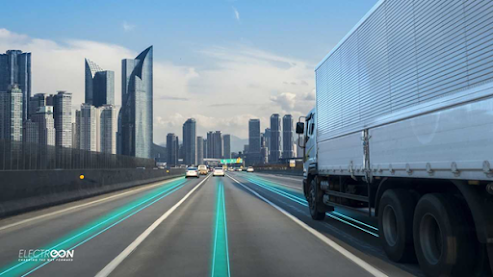
The road freight transport can be made more sustainable by the implementation of an electric road system (ERS) which provides electric power to trucks equipped with an electromotor by the use of an external power source. Electric road systems (ERS) provide a way of powering and charging a vehicle as it is driving along a road.

There are three main types of ERS:

·        Overhead lines: Two conductive lines are suspended over the road at a height of approximately 5meters to power heavy commercial vehicles.

·        Conductive track: These are simply conductive metal tracks installed in or on the surface of a road or sometimes along the side of the road.

·        Inductive track: These are buried conductive coils below the surface of the road. An electric current is induced in a coil on the bottom of the car.

Hybrid trucks consisting of an electromotor taking energy from an external source, as well as an on-board power source (fuel or energy-based), are used in these methods to ensure that the trucks have a continuous power source while they are not connected to the external grid. If the hybrid truck is fitted with a battery, the ERS and the regenerative braking system will then charge it.

This does not necessitate electrification of all highways. Rather, on long stretches of highways and in busy areas of urban road networks, charging zones will be included. Since 2016, these systems have been in trial service in Sweden and Germany on public highways.


Sweden is leading our way…..!!!

Road transport accounts for one-third of Sweden's carbon emissions, one-fourth of which is due to heavy freight transport. Sweden has committed to making a transport sector independent of fossil-fuel vehicles by 2030 as part of its climate protection strategy.


Sweden debuted the world’s first electrified road near Stockholm. South Korea and China also have been investing in solar-powered electromagnetic roads that recharge cars and trucks wirelessly to charge of EV batteries and reduce carbon emissions.

The world's first electrified road that uses a flexible arm to charge the batteries of moving vehicles recently debuted in Sweden. Two kilometers of the rail is embedded in a road near Stockholm. The road recharges vehicles' batteries as they move down it. It operates by using a movable arm that transfers the power from the rails to the vehicle battery by linking the vehicles to two electrified rails. The ERS decreases emissions of carbon dioxide by up to 90 percent. Even though The electrification of a kilometre of road costs around $1 million, it is 50 times less costly than the installation of an urban tram line. The strategy is to expand throughout Sweden to help minimise transport using fossil fuels by 70 percent by 2030 

There are a few other eco-sustainable solutions being used across the globe. South Korea developed a 12-kilometer asphalt roadway with electric cables in 2013, to build an electromagnetic field for wireless charging of moving passenger buses, China is testing a "intelligent highway" to produce electricity using solar panels to minimise transportation sector emissions. 

Over 100 years of electric vehicles

It was over 100 years ago, that the first electric cars were produced in US and they controlled the roads until around 1915. There are two methods for powering vehicles with electricity : stored battery power and direct feeds when in motion. Both of these techniques are more than 100 years old.

The challenges of using battery power

Even the best batteries could only store a fraction of the energy compared with the energy content of diesel, for example. This makes driving longer distances more difficult.

Is ERS a better economic solution?

Current infrastructure can be exploited by the electrification of roads to reduce energy use and carbon emissions. Electrified-road transport eliminates fossil emissions by 80 to 90 percent and is a cost-effective, climate-smart way of combining the benefits of rail with truck versatility. Due to substantial reductions in energy usage resulting from the use of powerful electric engines, operating costs would be minimal. Electricity is also a cleaner, quieter and less expensive source of energy, compared with diesel.

Reference

https://eroadarlanda.com/need-electrified-roads/

https://www.vti.se/en/news/electric-roads-a-solution-for-the-future/

https://www.engineering.com/AdvancedManufacturing/ArticleID/20157/Electric-Road-Systems.aspx

https://www.mckinsey.com/industries/capital-projects-and-infrastructure/our-insights/electric-road-systems-the-future-of-freight-transport

https://learningenglish.voanews.com/a/electrified-road-can-charge-vehicles-as-they-drive/4406280.html

https://www.sia-partners.com/en/news-and-publications/from-our-experts/electrified-road-freight-transport

Sunday, September 27, 2020

Cold chain management : Issues on supply chain of fruits and vegetables

 An apple a day keeps the doctor away : Cold chain management , Issues on supply chain of fruits and vegetables


India being in the tropics is blessed with diverse climate which is conducive to the farming of exotic ,seasonal and all round available cache of fruits and vegetables. India ranks second in the production of fruits and vegetables in the world . Increasing urbanization , nuclear families ,changing lifestyle ,more disposable income have opened up a consumerism which is highly conducive to the growth of the production of fruits and vegetables. Growth of supermarket chains ,organized retail and private label penetration have increased the demand for fresh fruits and vegetables which has been instrumental in the growth of the fruits and vegetable industry

Fruit & vegetables - ChainPoint

Issues in the supply chain of fruits and vegetables :


Though blessed with conducive climatic conditions that help in the cultivation of fruits and vegetables ,the main bottleneck that stifles this industry is the fact that the cold chain supply management is not highly evolved

There are numerous intermediaries working in isolation and the infrastructure connecting them is weak

There is no yardstick to measure it quantify the demand for the products . It is estimated that less than 4 percent of products are transported by cold chain in India compared to about 90 percent in the USA ,this results in about 440 billion dollars worth of products rotting.

Major roadblocks in the growth of the fruit and vegetable industry :


*Lack of cold chain facilities , inadequate cold chain  network etc are major bottleneck that stifles the industry . This prevents the farmers and businessmen to get proper remuneration

*Lack of supply chain infrastructure  is yet another element that chokes the life line of F & V industry . Proper infrastructure ensures that the product reaches on time and in perfect condition . Lack of infrastructure leads to loss

*High cost of packaging materials is another impediment . Unless the products are properly packaged their shelf life is reduced considerable .they are highly perishable goods hence the very best in packaging material which helps them breath ,while maintaining the temperature required is very essential .the high cost of packaging materials most of the times makes the farmers opt for cheaper materials which adversely affects the quality of the produce and directly affects the earning capacity of farmers


*The farmers still rely on obsolete technology to farm , harvest and pack . Post harvest handling also requires state of the art technology which we lag behind in India

*The farmers are often ignorant on the vast scope of the F &V market . Technological awareness is almost nil which doesn't give them an overview of the global market ,the actual value of their produce which makes them fall prey to intermediaries who fleece them off their rightful profit.thid coupled with lack of awareness in management of post harvest produce , the quality of seeds etc is highly detrimental .

*The demand for organic produce is on the rise . The quality ,freshness , the method of cultivation all add to the value of the produce . The lack of infrastructure ,awareness etc most of the times results in compromising on the quality of the produce which indirectly affects not only the profit of the farmer but also the health of the consumer .India doesn't have a proper quality check or standard in place to assess the quality of the produce .this makes our produce not export worthy .

*The farmers are most often victims of the unscrupulous interventions of the intermediaries who eat up most of the profit whereby the farmers are always in a state of perpetual penury.

*Last but not the least a major roadblock is the absence of a reliable transport system . We are famous for flash strikes ,Bharath bandhs etc which halt the freight movement leading to enormous losses to F&V industry .high cost of transportation ,lack of temperature controlled vehicles , good roads etc affect the movement of goods


Next time you bite into a fresh juicy apple from Simla  , a succulent Ratnagiri  mango  or a Nagpur orange ,thank a farmer and those involved to getting it across to you fresh and juicy .

Sunday, September 20, 2020

The World of Netflix

Hello Readers!!Welcome back to my blog.I'm Madhumitha.M from Amrita School of Business.😊

OTT is one of the main entertainment that made us feel little relaxed in this Covid lockdown.We just want to come back home after a long day's work, and forget our worries. 


Many of us turn to music, food, reading and even binge to watch our favourite Netflix TV shows.Netflix's technology is similar to the technology required nowadays in supply chain management.Lets see about the supply chain of Netflix and the reason that made it top in OTT platform.

1. Inventory Upkeep

       Movies and TV shows lose their appeal over time, so it is important for Netflix to keep their product fresh and refreshed and give their customers new content to retain them.This gets more difficult as owners of content when they do not licence their media.Netflix strategically curates content for it to become the go-to channel for media by deep processes and demand forecasting focused on user results.


2. On Demand Delivery

        Netflix allows its subscribers to watch their content at any time, anywhere.Customers can watch videos anywhere they are with no restriction to the amount of content they can access with streaming.It may also be used to stream in the supply chain. Logistics administrators are able to handle shipments in real time, identify their precise location and compile all the details.Real-time information gathering helps organisations not only to display and control their products end-to - end through their supply chain network at all time, but also to improve their supply chain operations.

3.Damage Control

        For each country in which they operate, Netflix uses a localised distribution model to distribute correct subtitles and artworks that highlight local celebrities from those countries and provide quality management over the entire package of digital properties. Ultimately, it is common sense for any company to provide structures and procedures at the final stage of the supply chain to review unmanufactured goods before they are marketed or becoming a part of another commodity. The basis of the popularity of Netflix is focused on powerful supply chain management that has helped them to become the go-to video streaming network.

4.Sourcing

        Netflix built their status as the leading go-to channel for entertainment, introducing quality management systems and certification mechanism that ensured that all content reached high expectations. The Netflix Distribution Norm for videos (4:3 aspect ratio) ultimately obtained assistance from post-production houses, who were mentored by a dedicated Netflix team. This removed the question of "different copies" from one copyright owner to another and allowed them to provide their clients with a seamless experience. Manufacturing companies that supply individual products from other players may aim to build a process stream to ensure the consistency and standardisation of their total pro players.


Thank You All !
Hope it’s interesting ☺️

Wednesday, September 9, 2020

Future Logistics 2 : Urban Air Mobility -Get Ready to fly


UAM: The Challenges and Possibilities

Hi, I’m Priyanka Sunil- A final year MBA student from Amrita School Of Business majoring in Operations and Marketing. Welcome to my progressive learning space for Logistics and Supply Chain Management.


As a kid, I was always fascinated by flying cars and always wished I was able to fly one during my lifetime. I remember watching Bruce Willis in the movie The Fifth element flying his cute yellow cab through the sky in the 23rd Century New York City.

For decades the fantasy of flying cars projected through comics, science fiction stories, television shows, and movies have captivated us.

By 2030, the urban population will be 60 percent of the world population. It is expected that this significant population growth will create a real need for innovative mobility options as ground infrastructure becomes increasingly overcrowded. A solution could be to provide people with a safe, sustainable, and convenient solution that leverages the airspace above towns

Urban air mobility (UAM) is an  aviation concept for on-demand and automatic passenger or cargo-carrying air transport systems usually operated without a pilot. This new programs, while reducing congestion, would offer new ways for people to travel across cities and metropolitan centers.


So where is your flying car?

Many start-ups and tech giants have started investing in the innovative technologies needed to make this dream a reality. Enabled by vertical-takeoff and -landing (VTOL) systems, electric propulsion, and advanced flight-control capabilities, these vehicles could eventually reach price points rivaling today’s taxi services. Airbus and Hyundai are among the few companies that have their own UAM divisions.

The companies should plan now to make this a reality as the timelines for designing and constructing these are really long. If they hold back until air-mobility solutions are ready to hit the skies, their drones will be the aerial equivalent of a bridge to nowhere: expensive technologic marvels that serve no purpose.

Physical Infrastructure to address the market

Flying vehicles need places to take off, land, receive maintenance, charge batteries, and refuel their tanks and park to offer sustainable service. This is further complicated by the fact that the demand to fly is different during different times of the day.

The physical infrastructure will be a major determinant of the size of the addressable market, as the only possible trips are between VTOL ports. Flying-vehicle transport could follow a pattern similar to that seen in today's helicopter market, where there is a limited number of potential destinations. The location of the infrastructure will determine the level of market conversion. If a landing spot is too far from its origin or destination, the customer may not save enough time to make sense of a trip to the UAM.

Illustrating the Infrastructure Network design

·       Vertihubs-Conceptualized as stand-alone buildings built-in central, high-traffic areas

·       Vertibases- To be located in medium-traffic areas like  suburbs, or at major work or retail locations

·       Vertipads- Typically located in suburban or rural locations

Pic: MCKinsey & Company

On the government side, there appears to be growing interest in infrastructure as well, with some public agencies investing in developing air-mobility infrastructure for drone use cases. They are also figuring out possibilities to integrate these systems with the existing air traffic management system.

Safety, convenience and sustainability

·       Many are electric vertical take-off and landing (eVTOL) aircraft designed for quiet, emission-free operation and energy conservation

·       Most manufacturers transfer the mechanical complexity as much as possible to the software to improve safety

·       The infrastructure will need to include takeoff and land points that are close to where people live and work

·       Riders will use an app to book their air taxi and will be able to browse flights based on route or time and integrate your personal electronic presence and devices with the buildings and infrastructure you have to move through.


Air-mobility solutions could transform commutes, package delivery and other mundane tasks into ways that seemed impossible just a few years ago. By making distant suburbs a viable option for urban workers, eVTOLs could help reduce pollution and alleviate the housing congestion in urban areas. Rapid delivery of the drone could speed up the already steep e-commerce spike and boost the bottom line at many companies. And air mobility's overall economic benefits could be immense, as new applications increase efficiency and productivity. First, however, companies, governments, and other stakeholders need to take careful steps to create an environment that allows for these societal benefits. Just as with any new industry, much is uncertain, but the potential for gains is also great.

Get Ready To FLY .....!!!!!

Reference

https://www.airbus.com/innovation/zero-emission/urban-air-mobility.html

https://www.honeywell.com/en-us/newsroom/news/2019/01/what-is-urban-air-mobility

https://www.mckinsey.com/industries/automotive-and-assembly/our-insights/to-take-off-flying-vehicles-first-need-places-to-land?cid=other-eml-alt-mip-mck&hlkid=bd756ecece11481ca3b5702705582e0c&hctky=12024655&hdpid=6b6acce2-37ab-4754-a105-af775901c0d2 


Supply Chain Dominance of China

Supply Chain Dominance of China A “Made in China” label has always been problematic in the U.S. In the early years of globalization, compani...