Showing posts with label Supply Chain Evolution. Show all posts

Monday, October 12, 2020

Cheese! Cheese! Cheese! ... So Cheesy ! How do they do it?

Hello everyone, I am Nikitha - A final year MBA student from Amrita School Of Business majoring in Operations and Marketing. I am back with my blog and this time I am going to enlighten you with something mouth-watering! Yes, In the next few paragraphs I am going to explain about CHEESE and how is it made. 

Cheese is a fermented food derived from the milk of various mammals. Since humans began to domesticate milk-producing animals around 10,000 B.C. , they have known about the propensity of milk to separate into curds and whey. It is the curds that are used to make cheese, and practically every culture on Earth has developed its own methods, the only major exceptions being China and the ancient Americas.

The first cheeses were "fresh," that is, not fermented, similar to today's cottage cheese aka Paneer. By A.D. 100 cheese makers in various countries knew how to press, ripen, and cure fresh cheeses, thereby creating a product that could be stored for long periods. Each country or region developed different types of cheese that reflected local ingredients and conditions. The number of cheeses thus developed is staggering. France, famous for the quality and variety of its cheeses, is home to about 400 commercially available cheeses.


The manufacturing Process:


The picture above gives a complete image of how cheese reaches your plate, Cheese manufacturing is a straightforward yet nuanced process. Larger cheesemaking factories have automated production lines, which yield mostly uniform results. In contrast, small batch cheesemakers or even those making cheeses in the comfort of their own homes may find that cheese can vary batch by batch depending on the conditions under which it’s made.

The first step in the manufacturing process is preparing the milk. It takes 10 pounds of milk to make one pound of cheese. Small batch cheesemakers typically use unpasteurized milk, which includes the bacteria needed to produce lactic acid (the agent that makes the cheese curdle). Larger factories use pasteurized milk and then add the bacteria separately.

Once the milk is prepared, rennet is added to it to separate the curds and whey. The curds can be cut using knives and then drained and pressed into molds. After the curds have been prepared, they are ready for aging (though some soft cheeses, like cottage cheese, don’t need to be aged). The length of the aging process varies, depending on the variety of cheese. The cheese might be bathed in brine to stimulate the growth of mold or rind and then stored in a room at the proper temperature and humidity. Some cheeses might be aged for only a month, while others — like extra sharp cheddar — might be set aside to age for up to two years.

Quality Control :

In the factory, quality control is ensured by rigorous inspectors who test the cheese for a variety of factors like texture, body, smell, and taste — and then assign points based on these characteristics.

Cheese manufacturing presents some unique challenges, particularly because of the debate surrounding pasteurized and unpasteurized milk. To ensure the health of consumers, the FDA requires that many cheeses be made from pasteurized milk, but it does allow producers to use unpasteurized milk as long as those cheeses will be aged for more than 60 days. Cheese lovers argue that since pasteurization destroys the natural bacteria needed to manufacture cheese, making cheese with pasteurized milk results in an inferior product. Ultimately, this can make things complicated when it comes to the import and export of cheese, as different countries have different regulations surrounding pasteurization.

Despite the ongoing debate surrounding pasteurization, there seem to be no sign of the cheese supply chain slowing down. Americans can rest assured that they’re very much on track to reach (if not surpass!) the predicted 37 pounds per capita consumption rate by 2025.


Thursday, October 8, 2020

How Data Analytics helps the improvement of Logistics Business?

 Data Analytics are started changing many industries, and logistics is not an exemption. The complex and dynamic nature of this sector, as well as the structure of the supply chain, make logistics a perfect use case for data. Valuable insights obtained through data leveraging allow industry players, for the benefit of both logistics and shipping companies. Although the data have to be highly processed and complex in nature,  it is worth the effort to embrace the data culture as advanced data analytics helps consolidate an industry that has historically been fragmented. The arrival and spread of the use of big data has changed the way organizations operate through their analytics drastically. 

According to the research, as much as 93% of shippers and 98% of third-party logistics companies believe that data analytics is critical to making intelligent decisions. 71% of them believe that big data improves quality and performance. 

Data and analytics are used by logistics firms to improve their activities for the following purposes:

  1. Performance Management: Performance managers will turn data findings into actionable outcomes, such as resource use management or distribution paths. For example, shippers expect the drivers to arrive on time, maintain schedules for docking, and avoid wasted time. Data will enable us to understand the performance of the workforce and track it. When data is exchanged amongst partners, it can be used to increase the effectiveness and transparency of the entire supply chain or network.
  2. Productivity Improvement: Real-time data sharing with all partners is essential. Especially for a logistics company and its partners, the experiences that a business collects are valuable. By capturing fluctuating customer demand, external factors, and the activities of the partners, this form of data sharing in logistics will help increase operational performance. It will improve accountability and help all stakeholders streamline their processes, thereby enhancing the efficiency of operational processes and the logistics company's overall results.
  3. Order Processing Capabilities: Getting accurate, successful integration of data into the systems frees up additional space for new orders to be entered. This eventually leads to further orders being shipped, which further drives demand within the supply chain for the services. As a result, an organization is improving and the amount of logistics data is rising to expose issues within the current processes.
  4. Route Optimization: The logistics industry uses data to improve delivery speed and provide real-time visibility of orders to customers. Consumers expect shipments to be fast and trackable easily. Continuously reviewing knowledge to optimize these organizational factors leads to higher quality relationships and enhanced customer loyalty.
The logistics industry is experiencing many changes and is adapting to the modern digital world, like many other industries. Leveraging data through disruptive innovations that allow businesses to provide better and new data and to use it in more robust applications is accelerating the road to a supply chain that is more productive and sustainable.

Sunday, September 6, 2020

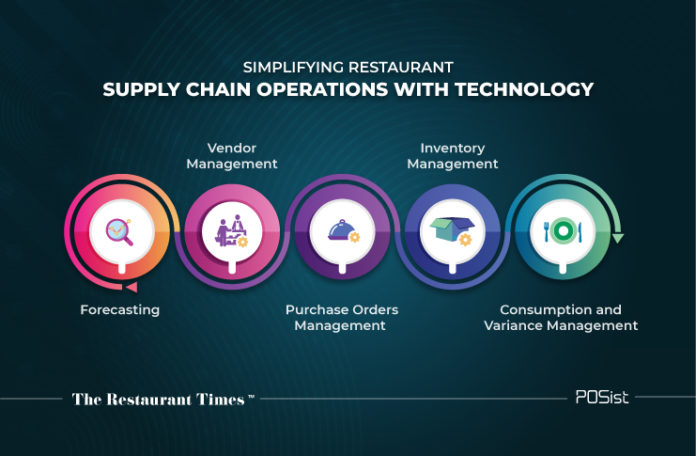
Streamlinig Restaurant Supply Chain with Technology.

The 5 basic supply chain components in restaurant industry

1. Demand sensing / Forecasting: The restaurant supply chain loop starts with a thorough understanding of market forecasting. This gives the restaurant a holistic approach of adapting its offerings and menu according to consumer demand.

 2. Sales management: It is important to find the best vendors in the restaurant industry to preserve consistency and productivity. It's also essential to use on-board technologies that helps handle vendors according to quality and performance. 

3.Purchase order management: The replenishment of orders differs even among restaurant chains with several locations, depending on various customer preferences. One outlet may require a different raw material from the other, or the volumes can vary.

4. Inventory management: When there is a 'loss of stock' problem, a big source of customer discontent is. Restaurants hold a adequate quantity of all the products or raw materials needed for food production to prevent mismanagement. Effective running of the supply chain means zero waste / failure.

  5. Demand and Variation Management: It is important for a restaurant to consider how much inventory is needed for preparing meals, and what the real consumption is. The variation contrasts the real stock (current counted inventory) to the ideal demand (stock value to be present). Consumption control is important to consider whether the employees at the restaurant are following a set of food quality guidelines.  

How Is Technology Solving The Supply Chain Complexities For The Restaurant Industry – Common Problems & Solutions

Technology leads to greater communication across the whole supply chain, allowing a deeper view of the processes. In a single forum, it binds all related parties participating in the process. All necessary information of the whole order period can be given with only a single press. 

Forecasting

 Projection or demand sensing is a crucial step in the overall cycle of supply chain activities in restaurants. 

Let's take the example of a food chain where Product X has achieved the highest revenue, to grasp this. Product Y was the least-selling item over the menu, however.Product Y did not do well in the industry, amid marketing efforts. Good X sales have declined owing to a lack in production due to business conditions. As a result the restaurant's net profits were affected.

This resulted in stock wastage which resulted in higher losses leading to cost-cutting across multiple operations, eventually impacting vendor relationships.


Simplifying Forecasting With Technology – Automated Forecasting Via Restaurant POS

An automatic forecasting platform offers prediction of the projected volume of revenue based on consumer demand trends. It's convenient to predict inventory needs based on the in-hand physical stock in the kitchen and the item-wise selling from each outlet. Demand sensor systems produce predictions for menu items as well as for raw material products. Restaurateurs can build exclusive deals for any channel on the menu items. Often, a proportionate inventory forecast excludes the problems relevant to raw material ageing. 

Vendor management

Vendor management is essential to the extent and complexity of a restaurant operation.If you're a fine-dine, a QSR line, or a business-grade operation, combining vendor-partners and monitoring them through technologies is important.

Bad vendor management can lead to:

 • Lack of the raw materials provided to a restaurant by the suppliers

 • The consistency of the products is degraded due to inadequate storage conditions

 • Distribution problem or delay in fulfilment of orders in due time

 • High operating costs resulting from economic conditions  

 Purchase Order Management

Say there's a two outlet restaurant chain that raises buying order depending on the typical criteria. It distributes the product to all of the distributors similarly. It is discovered shortly after an order has been shipped that one outlet is out of supplies, the second outlet has an large inventory and no storage facilities. The chain of restaurants often faces the dilemma of losing out on or getting the wrong piece. The existence of this condition suggests that each outlet 's product needs have not been analysed.


Simplifying Purchase Order Management With Technology – Analyse Outlet Level Stock Requirement Via Restaurant POS

With technologies in place, restaurants can track and evaluate sales-related purchase order criteria. The stock specifications for each outlet can be presented and analysed by restaurateurs. Purchase orders may be generated and delivered directly to the suppliers, depending on the specifications of each outlet. Restaurants use comprehensive statistics on demand and also lets them prepare their shipping. Both information relating to the order, such as status of the shipment, goods ordered, receivables are tracked. That the restaurant can keep a track of its product. Standard consistency is achieved through fair product delivery. All at fixed expense.


Reference : https://www.posist.com/restaurant-times/simplify-supply-chain-restaurants.html


Supply Chain Dominance of China

Supply Chain Dominance of China A “Made in China” label has always been problematic in the U.S. In the early years of globalization, compani...