Showing posts with label logistic. Show all posts

Sunday, October 18, 2020

Predictive Supply Chain


Predictive analytics is making a big splash in the logistics and supply chain industry. It provides information today on what we should be expecting tomorrow. One can imagine the benefit it applies to companies in retail or simply any company that faces challenges in logistics or supply chain. There are several predictions that can be done and how the supply chain is going to benefit from that.

Predict the demand of your products

Knowing the popularity of each of the products allows you to optimize your warehouse and the cost of your storage. High demand products, which are usually ordered frequently, should be put in the front of the warehouse, so that the time taken to pick and load reduces. On the other hand, products with lower demand which will not be ordered that often and therefore it can be put in the back of your warehouse. Also knowing the approximate demand of each of your products allows you to manage your inventory well. This will prevent over or under stocking.

Predict the demand of your customers.

Predicting the demand of your customers is slightly different from predicting the demand of your products, but it will give you a lot of new opportunities like knowing which customer will order which products on which day. This will give you more time to optimize your transport and one can make better decisions about outsourcing the orders to other parties. It also helps to optimize your human resource schedules. If you know peaks in your work load beforehand, you can choose to keep less people on standby. This reduces the costs and gives people a more predictable working environment.

Predict machine failure

Machine failure can cause part of the supply chain to slow down or stop completely until the problem is fixed. This can lead to severe costs. These days most machines are equipped with various sensors for various measurements such as temperature and voltage. These measurements can be combined with other information about the machine to predict whether the machine will fail. This allows you to schedule maintenance before the machine breaks. It also allows you to stall the maintenance on machines that are unlikely to fail in the near future. This reduces the cost of your operations. This is called predictive maintenance.

Investing in a predictive analytics solution is no longer an option, it has become a necessity to maintain competitiveness with all of the players who already benefit from emerging predictive technologies. Both consumers and organizations continue raising expectations to receive their shipments faster and cheaper. Therefore, those logistics and supply chain businesses that don’t invest in predictive technologies within their operations, might simply not survive in today’s demanding market.


Reference

https://transmetrics.eu/blog/how-predictive-analytics-is-transforming-logistics-and-supply-chain/

https://www.riverlogic.com/blog/supply-chain-predictive-analytics-what-is-it-and-whos-doing-it

Wednesday, October 7, 2020

DRONE SHIPPING


 Container ships transport more than 90 percent of all goods in the world and more than 4 trillion dollars worth of goods annually. But it can take over a month for those goods to sail from Beijing to New York. By land, trucks move nearly 71 percent of all freight tonnage. But the problem is, there are a shortage of truck drivers everywhere. So how do you speed up shipments while keeping personnel low?

The future of shipping looks very much unmanned. Anything that has high levels of customization, anything that's unpredictable, that could be done by air. Many startups believe the answer is autonomous flying cargo drones, that can carry heavy loads and fly long distances.

All around the world, millions of people are benefiting from drones already, and we're just at the tip of the iceberg. The global drone logistics and transportation market accounted for more than 24 million dollars in 2018, and that number is expected to grow to 1.6 billion dollars in 2027.

These drones could be the disruption needed in a global supply chain that has been largely unchanged since the 1950's. Getting large shipments of products across large distances is difficult. That's why Malcolm McLean created the shipping container in 1956. This standardized the shipping industry and allowed shipping to scale in ways that weren't possible before.

For a typical product that is being shipped from overseas and then received within the country, that would involve trucking, ocean freights, in some cases we are seeing the emergence of more rail being used as it's becoming a more reliable mode of transportation. But now, with programs like Amazon's one-day shipping, consumers are looking for goods to get to them faster. That means the standard shipping methods – ships and trucks – have to be re-evaluated.

There is a seemingly high demand for things right away by consumers and that just keeps growing and people become increasingly impossible over time. What it seems like is the supply chains, which are wildly complex, are built around the timeliness of air freight. But the cost per item for air freight is significantly more expensive, when compared to sea and ground shipping.

Air freight is actually a mode of transportation that has increased dramatically. It's still a small percentage of all freight being moved, but if you look at the percentage change over the years, air freight has been growing much more rapidly. I think a big reason for that is the growth of e-commerce. If you're living in a small village and you want to ship goods and be a part of a global economy, often your freight link is by road or rail and it takes quite some time for your goods to be transmitted around the world. So when we bring autonomy and scale into aviation, every community can be connected with the rest of the world through a airborne freight link.

But The main challenge is volume. You just can't lift as much weight into the air as you can floated along the sea, especially if you're trying to use battery powered vehicles like many of the smaller drones we see today. Current battery technology is incredibly heavy. Volans-i, a drone company that has been working in this space since 2015 created a hybrid vehicle that uses electric power to take off vertically, then standard fuel to fly off horizontally. So, if you build an all-electric vehicle, you have an 85 percent mass fraction on the batteries. So that means you can carry 15 percent the rest of the weight in payload, which doesn't really make sense for cargo delivery. The more volume you carry, the cheaper shipping becomes, even if that means traveling longer distances. Going in from Shanghai as an example, to the United States might take about 28 days by ship, whereas by airplane it'll only take 14 hours. But still, ships are cheaper.

Companies like Volans-i have already started making deliveries in places like the Bahamas, a particularly difficult area for deliveries because of the large distances between islands. The company's goal is to alleviate the shipping strains of high need, expensive shipping, like when a specific part needs replacing on a production line, and it needs to be replaced quickly since time is money.

Other companies are trying to lighten the load of the ever critical last-mile delivery. That's the portion of the shipping process that gets the product from its last warehouse or shipping hub to your door, and trying to hasten the delivery of medical supplies and samples for testing.

Zipline has been delivering supplies in Rwanda since 2016, Ghana since April of 2019 and is expanding its service to the U.S. this year. UPS has teamed up with drone startup Matternet to quickly ship medical supplies from a North Carolina hospital to labs for testing. I think we can use this type of system to massively improve health care in the country.

Autonomy brings a whole new set of public concerns, just as we've seen with self-driving cars, because the public has grown to appreciate the safety and the assurance of being able to fly from one place to another. The regulators are hesitant to permit new technologies from entering the airspace until they are really proven satisfactorily. Another big concern when it comes to automation is jobs. There would be this whole workforce needed to be able to manage this drone network.

This technology could help alleviate some of the worker shortages that the shipping industry is facing. I think that there is a great opportunity here with unmanned cargo aircraft to start proving out some of the technologies in a lower-risk environment without people on board, and these same technologies can eventually be introduced to the aircraft that we will use for flying around cities to and from work.

Sunday, October 4, 2020

Supply chain logistic management in the Indian army


 Jain hind Ki sena

Supply chain logistic management in the Indian army : 


 A vast land surrounded by trying terrains ,the Indian army has an leviathan task at hand . With 1, 129,000 active ,960,000 reserves and 158 air crafts standing guard at our borders ,the Indian army  the pride of the nation is the second largest standing army in the world . Infiltration by the Chinese , provocation from the Pakistanis and the never ending flow of refugees from Bangladesh are all concerns for the Indian army.

To thwart an enemy attack and to secure the boundaries is no easy task but the Indian army has always faced any eventuality with valor and efficiency

The Indian army is forever engaged in research,development  and acquisition of means to fortify itself .The acquisition of such capabilities requires much more than hardware . Armament is not it's only concern ,it also requires associated maintenance infrastructure , together with an assured supply chain and complete infrastructure for training .this ensures that the weapon system is sustained at the optimum level of performance by giving it  continuous back up maintenance and  having a fully proficient crew manning it .

The supply chain logistics in the military scenario has no parallel with any commercial supply chain either in scope or in the deadly serious nature of its operations . The uninterrupted supply chain is if paramount importance to the sovereignty of the nation as well as the security of life of its brave hearts standing guard .A small lapse or delay can be a matter of life and death ,of a war lost or won .

Early beginnings : a legacy from the British rule


We have to thank the British for handing to us on a platter well oiled and equipped array of workshops , depots which were developed to serve in the second world war.after independence ,the defense public sector undertakings and ordinance factories were established for manufacturing and developing defense armament under license .the public sector profile meant that there were always time run overs and capacity constraints ,so the services had to set up elaborate infrastructure for maintenance up to depot level repair and overhaul for not only the imported equipment's but also for the equipment license manufacture that these defense public sector undertakings and ordnance factories

Army supply chain : an overview


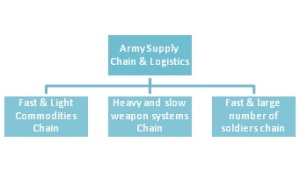
An army supply chain is a three tire alignment . First comes the chain that's fast and caters to moving light commodities like food , medicine and clothes .second comes the chain that transports  major heavy duty weapon systems that requires maintenance and repair over extended periods . The third is the deployment chain which moves large number of soldiers in very short time and in trying situations .unlike commercial supply chains army supply chain has reverse and lateral flows .as and when army inculcates a weapon in its arsenal it is entirely responsible for its maintenance , up gradation and disposition even as its users keep changing


Army supply chain divisions :


Untitled


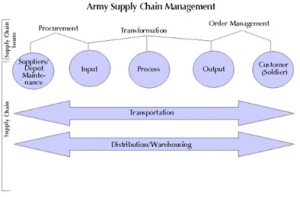
Typical army supply chain process flow

images


Up gradation and modernization:

In the last decades ,Indian army army has undergone s major change of improvement by integration of computer technology and adoption of flexibility in structure . It is shedding obsolete practices and outsourcing them to private concerns in the market .the various maintenance and up gradation contracts with private players is such an initiative to lessen the burden of did activities on army and to bring efficient resource management .the advent of globalization has had it's impact on the army's operations as various bills which aim at promoting collaboration

Which aim at promoting collaboration with foreign manufactures for development and research has given advancement in supply chain logistics


What the future holds :


India has one of the most hostile terrains along its border , the infrastructure needs much more development in order for the supply chain to be more efficient ,reliable ,safe and faster means of transportation network has to be created

The research and development wing of the army is galvanizing its efforts and making use of the cutting edge technology in it and logistics to maximize resource utilization so as to cater to any potential call for support from the forces

Most of the army's support systems are managed by obsolete government departments which are entwined in bureaucracy and red tap-ism .In order to tidy over this the army needs to outsource its support system to private operators on performance based contracts

The army conducts mock supply chain drills at regular intervals to keep a check on the bottlenecks ,loopholes and shortcomings so when an actual need arises they are adept at handling it


Conclusion :


They lay down their today's so our tomorrows are safe . When we go to bed in peace please remember to thank a soldier braving the odds and standing guard at sub zero temperatures , in rugged terrain , in makeshift bunkers .high morale ,patriotic to the core ,efficient and equipped ....

 That's Indian army for you . Serving you above self .

Supply Chain Dominance of China

Supply Chain Dominance of China A “Made in China” label has always been problematic in the U.S. In the early years of globalization, compani...