Showing posts with label supply chain challenge. Show all posts

Sunday, October 18, 2020

How can Supply-Chain recovers from pandemic situations


This is Vembu Raj T, pursuing my MBA second year in Amrita School of Business, Coimbatore. Today’s my blog is on topic “How can Supply-Chain recovers from pandemic situations”. From this blog we would know about the Steps now taken to mitigate the effects of coronavirus supply chains will also create resilience against things in future.

Businesses need to react at once on several fronts: while striving to protect the safety of their staff, they must also safeguard their organizational sustainability, now increasingly under threat from a historic supply chain shock. Many organizations are able to mobilize quickly and set up processes for crisis management, preferably in the form of a nerve center. Naturally, the usual emphasis is short-term. How will supply-chain leaders also plan and develop the resilience that will see them to the other side in the medium and long term?

  • Establish transparency in multi-stakeholder supply chains, draw up a list of essential products, decide the source of supply and identify alternative sources. 
  • Estimate the available inventory along the supply chain for use as a bridge to keep production going and allow consumers to deliver, including replacement parts and after-sales stock.
  • Evaluate reasonable final-customer demand and respond to (or contain, where possible) customer shortage-buying actions.
  • Optimize the ability of production and distribution to ensure the safety of workers, such as by providing personal protective equipment (PPE) and collaborating with contact teams to share levels of infection risk and work-from - home choices. These measures would make it possible for leaders to consider current and potential levels of capacity in both labor and materials.
  • Identify and secure logistics capacities, estimate and accelerate capacity, where possible, and, where necessary, be versatile in the mode of transport.
  • Manage cash and net working capital by conducting stress tests to understand when a financial effect will begin to be generated by supply chain problems.

Saturday, October 17, 2020

Why did the chicken cross the road? - Well let's ask KFC


Hello Ladies & Gentlemen!

This week we are going to have a look at one of the biggest food retail chain organization and their supply chain disaster. To answer the question "Why did the chicken cross the road? It's because KFC couldn't get it to their store. This was a famous joke at the beginning of the year 2018, as KFC ran into several logistics problems. 

So what happened exactly? In the month of February 2018, KFC switched their logistics from Bidvest to DHL, without conducting any trial runs. On Valentine's day, there were two collisions on the M6 motorway which caused the death of one person and leaving a couple of others injured. The junctions at where it happened were near to the DHL warehouse. There were traffic blocks for several hours, making those roads completely inaccessible. A couple of trucks that were stuck in the traffic includes trucks from the KFC warehouse. That was a single warehouse located in the golden rectangle. The golden rectangle is a location such that, if you have a facility there, you can transport any goods across the UK in one night. But this didn't turn out too well for KFC as the roads leading to it were blocked for several hours.

This caused KFC to shut down various outlets of its as they were running out of chicken. Also, some of the stats say about two-thirds of their outlets were closed due to a shortage of chicken. While analyzing where they went wrong, they realized the storm caught up at the wrong time. This was the time where they were handing over from one logistics service to another and before even it became complete, they were caught in the crisis. Some of the mistakes made by KFC are lack of experience in logistics, no plan A, B, or C, improper cost-cutting, no contingency planning, lack of communication & safety.

So what they should have done or should do? Well for starters, make a proper plan such that it involves all the possible outcomes which would help them to be ready for however worst the outcome is. Looking out for a well-experienced outsourcing partner in your area of expertise. It's not important that they are good at overall experience but what needs to be known is, does my vendor have experience in treating products very similar to mine. The 1st and foremost thing is to do a test run before starting anything new, which KFC forgot to do it. Last but not least, never put all eggs in one basket, DHL used only a single warehouse thinking that would save a lot of costs but that cost them a fortune. 

These are not only lessons for them but for everyone out there, as situations are unpredictable, it's always best to be prepared for the worst. I will end my final words by quoting Virat Kohli's statement to a fan "Don't look for success, look for failures because the latter teaches you more".

Adios, Amigo!

-Varadharaju R


Monday, October 12, 2020

Cheese! Cheese! Cheese! ... So Cheesy ! How do they do it?

Hello everyone, I am Nikitha - A final year MBA student from Amrita School Of Business majoring in Operations and MarketingI am back with my blog and this time I am going to enlighten you with something mouth-watering! Yes, In the next few paragraphs I am going to explain about CHEESE and how is it made. 

Cheese is a fermented food derived from the milk of various mammals. Since humans began to domesticate milk-producing animals around 10,000 B.C. , they have known about the propensity of milk to separate into curds and whey. It is the curds that are used to make cheese, and practically every culture on Earth has developed its own methods, the only major exceptions being China and the ancient Americas.

The first cheeses were "fresh," that is, not fermented, similar to today's cottage cheese aka Paneer. By A.D. 100 cheese makers in various countries knew how to press, ripen, and cure fresh cheeses, thereby creating a product that could be stored for long periods. Each country or region developed different types of cheese that reflected local ingredients and conditions. The number of cheeses thus developed is staggering. France, famous for the quality and variety of its cheeses, is home to about 400 commercially available cheeses.


The manufacturing Process:


The picture above gives a complete image of how cheese reaches your plate, Cheese manufacturing is a straightforward yet nuanced process. Larger cheesemaking factories have automated production lines, which yield mostly uniform results. In contrast, small batch cheesemakers or even those making cheeses in the comfort of their own homes may find that cheese can vary batch by batch depending on the conditions under which it’s made.

The first step in the manufacturing process is preparing the milk. It takes 10 pounds of milk to make one pound of cheese. Small batch cheesemakers typically use unpasteurized milk, which includes the bacteria needed to produce lactic acid (the agent that makes the cheese curdle). Larger factories use pasteurized milk and then add the bacteria separately.

Once the milk is prepared, rennet is added to it to separate the curds and whey. The curds can be cut using knives and then drained and pressed into molds. After the curds have been prepared, they are ready for aging (though some soft cheeses, like cottage cheese, don’t need to be aged). The length of the aging process varies, depending on the variety of cheese. The cheese might be bathed in brine to stimulate the growth of mold or rind and then stored in a room at the proper temperature and humidity. Some cheeses might be aged for only a month, while others — like extra sharp cheddar — might be set aside to age for up to two years.

Quality Control :

In the factory, quality control is ensured by rigorous inspectors who test the cheese for a variety of factors like texture, body, smell, and taste — and then assign points based on these characteristics.

Cheese manufacturing presents some unique challenges, particularly because of the debate surrounding pasteurized and unpasteurized milk. To ensure the health of consumers, the FDA requires that many cheeses be made from pasteurized milk, but it does allow producers to use unpasteurized milk as long as those cheeses will be aged for more than 60 days. Cheese lovers argue that since pasteurization destroys the natural bacteria needed to manufacture cheese, making cheese with pasteurized milk results in an inferior product. Ultimately, this can make things complicated when it comes to the import and export of cheese, as different countries have different regulations surrounding pasteurization.

Despite the ongoing debate surrounding pasteurization, there seem to be no sign of the cheese supply chain slowing down. Americans can rest assured that they’re very much on track to reach (if not surpass!) the predicted 37 pounds per capita consumption rate by 2025.


Saturday, October 10, 2020

SCM for Hospitals


INTRODUCTION

Healthcare supply chain management involves obtaining resources, managing supplies, and delivering goods and services to providers and patients. In healthcare, managing the supply chain is typically a very complex and fragmented process.

Suppply chain mngt


SUPPLY CHAIN MANAGEMENT PROCESS

SUPPLY CHAIN MANAGEMENT PROCESS

THE IMPORTANCE OF SUPPLY CHAIN MANAGEMENT

1. Boost Customer Service

2. Reduce Operating Costs

  • Decreases Purchasing Cost
  • Decreases Production Cost
  • Decreases Total Supply Chain Cost

3. Improve Financial Position

  • Increases Profit Leverage
  • Decreases Fixed Assets
  • Increases Cash Flow

FIVE HEALTH CARE SUPPLY CHAIN MANAGEMENT TRENDS

1. Web-based tech will push health care supply chain management market past $2.2 billion by 2021

In four years, the size of the supply chain management industry for health care will hit $2.22 billion. A variety of factors are driving market growth, including compliance with the Specific Recognition Initiative of the Food and Drug Administration, increasing pressure on hospitals and health systems to increase operational performance and profitability, and the acceptance of technologies for cloud-based supply chain management. Web-based models help minimise administrative and operating costs, citing that technology as a particular area of growth for health care organizations.

2. Use of data and analytics to drive supply chain management performance will increase

The need to reliably forecast supply chain outcomes will drive the increased use of advanced analytics to improve supply chain management performance.

3. Push for population health management will reshape health care supply chain management

Population health management – the art and science of keeping healthy people healthy and people with chronic medical conditions as healthy as possible – will remake health care supply chain management.

4. Risk-based contracting between providers and suppliers will redefine supply chain relationships

As health care providers assume more clinical and financial risk under value-based reimbursement contracts with payers, they want to share that risk with their suppliers.

5. Health care supply chain leaders will need to upgrade and expand their skill set in the future

In four competencies, the "ideal" supply chain leader would excel: communication, negotiation,analytics and presentation. They will have health care, supply chain, people management, project management and technology expertise.They will have an advanced degree be accredited and have leadership training in Lean / Six Sigma. Their five ideal personal characteristics are the capacity to see the big picture, to be an active listener, to be successful individually, to be versatile and to be ethical.

CHALLENGES FOR SUPPLY CHAIN MANAGEMENT FOR HOSPITAL

1. Hidden Costs

2. Drug Shortages

3. Data Shortage

4. Lack of Integration

5. Poor Workflow Design


Sunday, September 6, 2020

Learning it the hard way- Lessons from Supply Chain Failures


Learning it the hard way- Lessons from SC Failures

Hi, I’m Priyanka Sunil- A final year MBA student from Amrita School Of Business majoring in Operations and Marketing. Welcome to my progressive learning space for Logistics and Supply Chain Management.

Companies face many challenges when trying to manage social and environmental issues in the supply chain. Supply chain risk is an enterprise-wide risk. Decisions made in the product design and development stage, decisions made about locating production facilities, manufacturing technologies, purchasing components and the choice of suppliers, decisions made about outsourcing functions, services, marketing and distribution strategy, and many other strategic and operational decisions, can all have an impact on the ultimate level of supply chain risk.

Following are the details of some recent supply chain disruptions to illustrate the range of events that can cause such disruptions and the scale of impacts such disruptions can cause to the companies involved, both directly and indirectly. 


1.     GM  Supply Chain Disaster: Automation gone wrong

PC: bloncampus

At the moment, robots still seem like a smart idea, before they chase you down the street and free yourself from liquid puddles. With Short Circuit still fresh in mind in the 1980s, but obviously not Terminator, then General Motor's CEO Roger Smith, agreed to embark on a drive to increase the number of robots in GM plants from 300 to 14,000 by 1990. With Japan's robot designer Fujitsu-Fanuc, Smith set up a joint venture to make his dream come true, investing billions of dollars in the process.

The robots sadly weren't running. Instead, the rest of their time was spent painting themselves and lowering windshields. Productivity fell, prices soared and market share shrank. Smith was released.


2.     Main impact on Land Rover

UPF-Thompson, the sole supplier of chassis frames to Land Rover (then a subsidiary of Ford) for its Discovery models, unexpectedly went bankrupt on 4 December 2001 with debts of around £75 million. This threatened the jobs of 1,400 Discovery production line workers and 10,000 employees at companies that made parts for the Discovery.

KPMG, the receivers for UPF-Thompson, threatened to stop the supply of chassis frames to Land Rover, unless Land Rover made a goodwill payment of £35 million to UPF-Thompson. KPMG justified its actions by pointing out that it was legally obliged to recover money on behalf of UPF-Thompson’s creditors and the sole supplier agreement represented a valuable asset. After Land Rover won a temporary injunction against this threat on 11 January to maintain the flow of chassis frames into its Solihull plant, it put £1 million into UPF-Thompson, which looked likely to find a buyer if the company was guaranteed a new contract to supply chassis frames to Land Rover.

After further legal action, an agreement was finally reached between Land Rover and KPMG in February 2002139, under which Land Rover was believed to have paid between £10 million and £20 million of UPF-Thompson’s debt in exchange for the replacement of KPMG by its preferred receivers, Grant Thornton.


3.     KFC’s Supply Chain Crisis

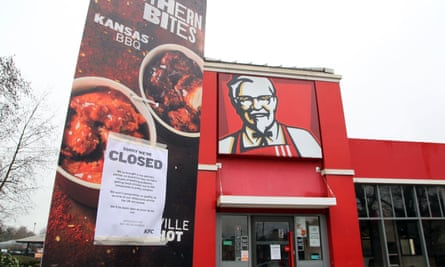
A closed sign outside a KFC restaurant in Ashford, Kent.
Photograph: Gareth Fuller/PA

The supply chain crisis for the KFC closed over half of the company's 900 U.K. in 2018. KFC had switched to a new delivery company, causing their food supply chain to suffer significant disruptions. Many of the stores were forced to close without deliveries of fresh chicken-a transport logistics problem that experts estimate cost KFC up to £ 1Million per day.

However, the fast-food giant graciously and with a sense of humor approached the situation, using social media to respond to questions instantly and honestly. The company has also built a page on its website so that consumers can see which stores are still available. In addition, they continued to pay their employees even though restaurants did not serve clients.

 
4.  Mattel Toys – Product Recall

Mattel, Inc: The Lead Paint Recall | Center For Digital Strategies

Photograph: https://digitalstrategies.tuck.dartmouth.edu/

Like many toy manufacturers, Mattel had occasional product recalls, but was then forced to make a series of toy recalls in 2007149. There were two main causes. Firstly, small magnets inside various toy figures or accessories (such as Batman, Barbie, Doggie Day, Polly Pocket) could fall out and be swallowed or aspirated by young children; if more than one magnet was swallowed, the magnets could then attract each other and cause intestinal perforation or blockage, which could have been fatal.

Secondly, surface paints on various toys and accessories contained excessive levels of lead, which was prohibited under federal law; lead is toxic if ingested by young children and can cause adverse health effects. In the worst cases, some of Mattel’s toys had levels of lead in paint that was 180 times the US Federal limit150. All the affected toys, magnets and lead paint were manufactured in China.

Although the products concerned represented a small fraction of China’s exports, worth more than $1 trillion per year, Chinese officials worried that the US government could use these quality problems to restrict trade. Zheng Xiayou, the head of China’s state food and drug administration over the period 1998 to 2005, was convicted of dereliction of duty and taking bribes from manufacturers of the substandard medicines that had been blamed for several deaths – and was executed on 10 July 2007.


5.     Adidas goes for broke

Adidas global HR head resigns as company tackles diversity issues |  BusinessMirror

Photograph: businessmirror.com

Starting in 1993, Adidas attempted to implement two new management systems at its distribution center in Spartanburg, insisting that the system of Integrated Software Logistics Engineering be ported to fault-tolerant Stratus computers. Adidas ploughed ahead despite the device not being ready. It just didn't work.

The sports brand under shipped by an estimated 80 percent, and it took years to regain its lost market share.

As the above-mentioned businesses have proved, reliable goods and innovative campaigns are essential components of growth, but there is no substitution for a stable and well-performed supply chain after all. We all know products change rapidly in the supply chain. Yeah, some supply chain no-nos were listed here.


Takeaways

Snags are unavoidable therefore damage prevention has to be a key market priority. Running pilots is a must and there are also simulation technologies to test supply chain operations. Being open and attentive to the needs of consumers and working diligently to solve the issue can be an incentive to develop trust and improve client relationships. To scale it is important for businesses to have the proper supply chain infrastructure. This includes structures and a plan for anticipating and projecting demand to proactively satisfy consumer needs -eliminating the requirement for inventory effectively rationing and underpinning high demand markets. There are countless possibilities for any cautionary tale to communicate more with your customer base and entertain new customers. And the correct tools for handling the supply chain will prepare you to leap on opportunities.

 References

https://bloncampus.thehindubusinessline.com/columns/world-view/the-abject-failure-that-is-general-motors/article25624078.ece

https://www.thebci.org/news/supply-chain-failure-closes-more-than-half-of-kfc-fast-food-outlets.html

https://www.autonews.com/article/20020211/SUB/202110807/supplier-failure-hurts-land-rover

https://www.nytimes.com/2007/08/15/business/worldbusiness/15imports.html#:~:text=Mattel%2C%20the%20world's%20largest%20toy,are%20covered%20with%20lead%20paint.

Friday, August 21, 2020

Saint-Gobain Flat Glass SCM


How do they move flat glass?

    Sea shipping is the easiest method of transporting for intercontinental distribution, with sufficiently long lead times, and extra storage and packing costs. Otherwise, both by train and by truck road transportation is feasible. The train should only be used for large quantities, with significant lead times. Trucks are the most versatile means of transportation for short-distance delivery and for limited volumes. An inloader is a special truck specially designed to carry large-sized glass sheets (called Plateau Largeur Fabricationd PLF). The peculiar issue is that inloaders can only hold the glass (PLF). it fills the glass trestle directly. It loads the glass trestle directly. PLF can also only be shipped by inloaders.

Inloader Truck.

    Therefore the loading and unloading periods for dedicated glass trestles are reduced. The inloader fleet, however, is small, and peak times can be crucial to having a truck on-hand. Nowadays, the bill for each supply includes the round trip kilometers in the case of internal as well as external transport. The travel rates are also greater than historically. This problem is solved by optimizing the reloading time on deliveries. If an inloader is discharged at a point near its potential loading spot, the empty truck kilometers will be minimized. This is the reason why shipping costs rely on flow style transfers between plants or replenishment of any logistics network to be cheaper than any delivery to customers. The reloading rate may preferably be about 100 percent in the first scenario, while in the second it may be up to 75 percent. Ultimately, given the general cost structure of the raw goods, shipping costs tend to be a crucial element in the glass sector requiring an effective supply chain.


Supply Chain Dominance of China

Supply Chain Dominance of China A “Made in China” label has always been problematic in the U.S. In the early years of globalization, compani...